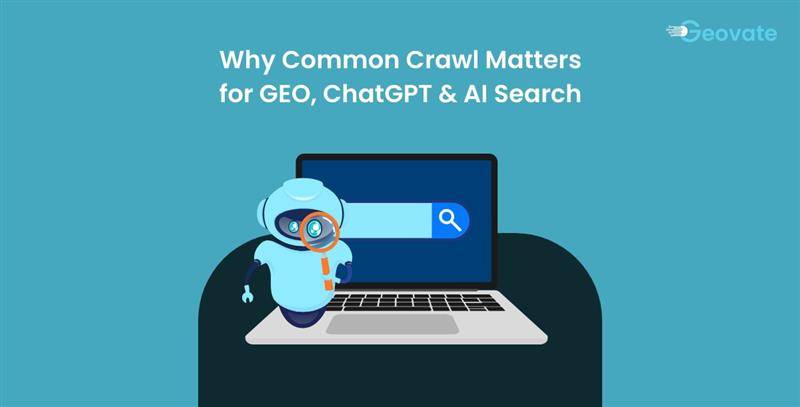
Why Common Crawl Matters for GEO, ChatGPT & AI Search
Fri,19 Sep 2025 14:54:00- Font Size
- Share Content
The world of search is changing faster than ever. Traditional Search Engine Optimization (SEO)—long the gold standard for online visibility—is now evolving into Generative Engine Optimization (GEO). With AI models like ChatGPT, Claude, and Gemini becoming new gateways to information, the way your content gets discovered, indexed, and used is fundamentally different.
Unlike search engines that crawl and rank content for direct retrieval, generative AI tools are trained on massive datasets. These datasets determine what the model “knows” and how it responds to user queries. One of the most critical of these datasets is Common Crawl—a nonprofit project that openly crawls the web and makes its archive available to anyone.
If your website isn’t accessible to Common Crawl, your content risks being invisible in the training pipelines of AI models. And that means your brand may not show up when users turn to ChatGPT for answers. In other words, understanding how to rank on ChatGPT is directly connected to whether your content is eligible for Common Crawl.
What Is Common Crawl and Why It Matters
Common Crawl is an independent nonprofit organization that scans billions of web pages every month and creates open-source archives of the internet. These archives include HTML pages, metadata, text extracts, and other structured datasets.
Here’s why it matters for GEO:
1. Open and Freely Available
Unlike proprietary search indexes, Common Crawl data is open for anyone to use—including researchers, startups, and AI labs.
2. Influences AI Training
Large language models such as GPT-3 (and likely GPT-4) rely heavily on Common Crawl data. For GPT-3, roughly 60% of the training corpus came from Common Crawl, meaning it shaped much of what the model “knew.”
3. Acts as a Gateway
If your website is missing from Common Crawl, it’s effectively absent from one of the world’s largest training resources. That absence lowers the odds of your content shaping ChatGPT’s responses.
The Evolution of AI Training Data: From GPT-3 to GPT-4
When GPT-3 was launched, OpenAI was transparent about its training data:
- 60% Common Crawl
- 22% WebText2 (curated web pages)
- 16% Books
- 3% Wikipedia
This breakdown shows how dominant Common Crawl was. But with GPT-4, OpenAI has been silent about exact sources. Still, experts widely agree that Common Crawl remains an essential component, simply because of its size and open availability.
Why Transparency Changed
- Competitive secrecy: As AI became a competitive industry, companies grew cautious about revealing methods.
- Data debates: Legal and ethical scrutiny around copyrighted sources increased.
But regardless of disclosure, the principle holds true: if your site isn’t part of these foundational datasets, it won’t be a knowledge source for generative AI.
GEO vs. SEO: A New Frontier
For years, businesses optimized for Google Search visibility by focusing on keywords, backlinks, and technical SEO. But now, with AI assistants becoming an everyday search replacement, a new layer emerges: Generative Engine Optimization (GEO).
Key Differences
- SEO: Optimizes content for retrieval by a search engine algorithm.
- GEO: Optimizes content for inclusion in AI training datasets.
Why Common Crawl Is Central to GEO
While Googlebot decides what content appears in search results, Common Crawl determines much of what gets absorbed into AI training. If your content is excluded, you may never appear in conversational AI outputs—even if you dominate Google rankings. For brands exploring how to rank in ChatGPT, this inclusion is a non-negotiable first step.
Barriers to Common Crawl Inclusion
Many businesses unknowingly block themselves from Common Crawl. Here are the most common barriers:
1. Robots.txt Restrictions
If your robots.txt file blocks Common Crawl’s user agents, your content won’t be indexed.
2. Login-Restricted Content
Anything behind a paywall, membership login, or gated portal is invisible to open crawlers.
3. Private Networks or Subdomains
Internal tools, staging sites, or private CMS instances often escape crawl visibility.
4. Technical Errors
Broken links, 404s, slow servers, or misconfigured security settings can prevent crawlers from accessing content.
How to Ensure Your Site Is Eligible for Common Crawl
If you want to future-proof your visibility in AI-driven ecosystems, here’s what to do:
1. Check Your Robots.txt
- Verify that Common Crawl’s user agent (CCBot) is not blocked.
Example:
User-agent: CCBot
Allow: /
2. Test Crawlability
Use online tools or server logs to confirm whether CCBot is visiting your site.
3. Focus on Accessibility
- Ensure your site loads quickly and returns correct HTTP status codes.
- Avoid heavy reliance on JavaScript that hides key content.
4. Publish Public-Facing Content
Create content that lives outside gated platforms like LinkedIn, Twitter, or private communities.
5. Leverage Evergreen and Authoritative Content
AI models reward high-quality, authoritative, and evergreen material since these datasets are used to build general knowledge.
Why Businesses Should Care Now
The timing couldn’t be more critical. AI assistants are rapidly becoming the default interface for information retrieval. Consider these shifts:
- Consumer Behavior: People now “ask ChatGPT” instead of Googling.
- Enterprise Search: Companies deploy AI copilots trained on both internal and public data.
- Discoverability: Visibility in generative outputs can drive traffic, leads, and authority.
If your content isn’t feeding these models, you risk digital invisibility in the next era of search.
The Bigger Picture: From Search Engine First to AI First
Think of Common Crawl eligibility as the first step in an AI-first digital strategy. Businesses that optimize now will enjoy first-mover advantages, just like early adopters of SEO did in the 2000s.
- In SEO, the goal was ranking on Google’s first page.
- In GEO, the goal is being absorbed into AI knowledge bases.
Those who ignore this transition may find their competitors dominating conversations in ChatGPT while their brand is absent entirely.
Practical GEO Strategy for Businesses
To integrate Common Crawl into your strategy:
1. Audit: Run a technical audit specifically for crawler access.
2. Content Plan: Focus on long-form, educational, and evergreen pieces.
3. Monitor: Regularly check whether your domain is present in Common Crawl’s archives.
4. Expand: Diversify publishing beyond platforms that don’t contribute to training datasets.
5. Future-Proof: Treat GEO as an ongoing discipline, not a one-time task.
Conclusion:
The internet is no longer just a search-driven ecosystem—it’s becoming a knowledge layer for AI systems. Common Crawl is one of the most important bridges between your website and ChatGPT’s training data.
To stay visible in this evolving landscape, businesses must adapt. Ensuring your site is eligible for Common Crawl isn’t just technical hygiene—it’s the foundation of Generative Engine Optimization. By taking action now, you’ll position your brand to remain relevant and discoverable in the age of AI-driven search.
Frequently Asked Questions
Q1. What is Common Crawl in simple terms?
Common Crawl is a nonprofit project that scans the web, collects data, and makes it freely available for research, analysis, and AI training.
Q2. How does Common Crawl affect ChatGPT?
Much of ChatGPT’s earlier training data came from Common Crawl archives. If your content isn’t included, it’s less likely to influence the model’s outputs.
Q3. Can I check if my website is in Common Crawl?
Yes. You can explore the Common Crawl index or use third-party tools to verify whether your domain is present.
Q4. What should I do if my site is blocked from Common Crawl?
Review your robots.txt file, ensure CCBot is allowed, and fix any technical issues that prevent crawling.
Q5. Is optimizing for Common Crawl different from SEO?
Yes. SEO focuses on ranking in search engines, while optimizing for Common Crawl ensures your content can be part of AI training datasets—critical for visibility in ChatGPT and especially important if you’re exploring how to rank on ChatGPT or how to rank in ChatGPT effectively.