Why Google Indexing Is the New SEO for Generative AI and ChatGPT
Wed,10 Sep 2025 12:48:00- Font Size
- Share Content
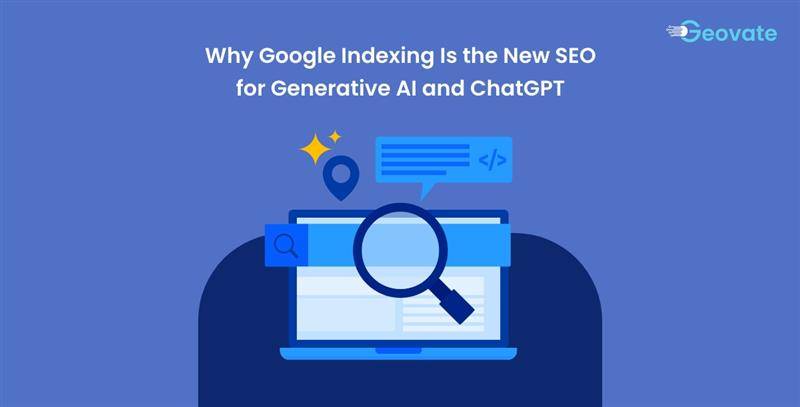
The way users search is changing rapidly. Generative AI platforms such as ChatGPT, Gemini, and Perplexity are no longer just novelties—they are becoming everyday information gateways. But here’s the surprising part: these AI tools aren’t building their knowledge from scratch. Instead, many rely heavily on Google’s index to fetch, verify, and present information.
For businesses and agencies like Geovate, this shift introduces both a challenge and an opportunity. The challenge? Traditional SEO strategies are no longer enough. The opportunity? Brands that understand how Google indexing now powers AI visibility can position themselves at the forefront of the digital future.
The Experiment That Changed SEO Forever
How the Discovery Was Made
SEO experts ran experiments that revealed how ChatGPT Plus with browsing enabled pulls information directly from Google’s live index.
- Step 1: They created a new page with a made-up term (NexorbalOptimization) and submitted it only to Google.
- Step 2: They blocked Bing and other crawlers.
- Step 3: Within hours, ChatGPT started quoting the content word-for-word.
The results? Generative AI tools were relying on Google’s index—not just Bing or their own internal training data.
Why It Matters
For years, SEOs focused on rankings within search engines. But if Google’s index is now the foundation of AI answers, then content visibility extends far beyond search results. It stretches into AI-driven conversations, product recommendations, and knowledge graphs.
What This Means for SEO Today
1. Indexing Comes Before Ranking
In the AI era, if your content isn’t indexed by Google, it doesn’t exist. AI won’t surface it, users won’t see it, and your brand will stay invisible. This makes indexing the first, non-negotiable step.
2. Structured Content Wins
AI thrives on clarity. That means clean headings, concise definitions, and schema markup are more powerful than ever. Think about how ChatGPT generates answers—it looks for direct, well-structured information.
3. Beyond Rankings: Tracking AI Mentions
Instead of obsessing only over SERP rankings, brands now need to track:
- How often their content appears in ChatGPT answers
- Whether Gemini summaries cite their site
- How Perplexity references their brand
This broader measurement is the future of SEO.
4. GEO: Generative Engine Optimization
SEO alone isn’t enough anymore. Enter Generative Engine Optimization (GEO)—the practice of optimizing content for generative AI platforms. From using metadata like llms.txt to structuring snippet-friendly content, GEO ensures your brand is AI-visible.
Geovate’s AI-Ready SEO Playbook
Here’s how Geovate—and brands adopting forward-thinking strategies—can master SEO in the generative AI age:
Step 1: Ensure Comprehensive Google Indexing
- Use Google Search Console to submit key pages.
- Build strong internal linking to signal content priority.
- Audit for “Crawled but Not Indexed” issues and resolve them quickly.
Step 2: Structure Content for AI Uptake
- Use H2 and H3 headings that mirror user queries.
- Add FAQ and How-To schema to increase snippet eligibility.
- Provide direct answer sentences to feed AI responses effectively.
Step 3: Monitor AI Visibility
- Track mentions in ChatGPT outputs.
- Monitor Google SGE (Search Generative Experience) appearances.
- Use SEO tools with AI-tracking features for better insights.
Step 4: Embrace GEO
- Implement AI-specific metadata (
llms.txt). - Create snippet-friendly definitions and short summaries.
- Optimize for AI retrieval by reducing fluff and improving clarity.
Step 5: Align Technical SEO with AI
- Ensure pages are crawlable without heavy JavaScript.
- Maintain a logical, clean site architecture.
- Keep metadata simple, consistent, and accurate.
Benefits for Geovate and Clients
- Google Indexing: Ensures visibility across AI platforms
- Structured Content: Increases AI accuracy when referencing your site
- GEO Practices: Puts Geovate ahead of competitors still focused on old SEO
- AI Visibility Tracking: Expands measurement beyond rankings into generative discovery.
- Technical SEO Alignment: Future-proofs content against evolving AI search methods.
Practical Example: How This Works
Imagine Geovate publishes an article on “The Future of No-Code Tools.”
- If it’s indexed by Google within 24 hours, ChatGPT may start quoting it.
- Gemini might surface it in Search Generative Experience cards.
- Perplexity could summarize it when users ask for “best no-code platforms.”
Without indexing, that same article would simply not exist in the AI ecosystem—even if perfectly optimized for traditional SEO.
Looking Ahead: The Convergence of SEO and AI
The relationship between Google indexing and AI visibility is still evolving. But one thing is clear: brands that adapt early will capture disproportionate visibility in the AI era.
For Geovate, this means positioning not just as an SEO expert, but as a GEO leader—helping clients become discoverable across both search engines and generative AI platforms.
Conclusion
The SEO game has changed. Google’s index is no longer just the backbone of search—it’s becoming the data spine of generative AI.
For Geovate, this presents a huge opportunity:
- Prioritize indexing.
- Structure content for AI.
- Embrace Generative Engine Optimization (GEO).
- Track success not only in rankings but also in AI visibility.
By adopting this AI-first SEO strategy, Geovate and its clients will not just survive the shift—they’ll lead it.
Frequently Asked Questions
Q1. How does Google’s index power generative AI like ChatGPT?
Google’s index acts as a massive, constantly updated database of web content. When tools like ChatGPT fetch live information, they often pull it from Google’s index. This means that if your content isn’t indexed by Google, it’s less likely to appear in AI-generated answers or summaries.
Q2. Why is indexing more important than ranking in the AI era?
Traditional SEO focuses on rankings within search results, but AI tools don’t necessarily show ranked SERPs—they generate answers. That means if your page isn’t indexed, it won’t appear at all in AI responses. In the AI-first era, indexing is the gateway to visibility.
Q3. Does ChatGPT crawl websites like Google does?
No, ChatGPT does not crawl the web in the same way as Google or Bing. Instead, it relies on indexes and integrations from search engines, combined with its own training data and partnerships. Recent evidence suggests it leans heavily on Google’s index to surface live results.
Q4. How is ChatGPT search different from Google search?
Google search is a traditional index-driven search engine, showing direct links ranked by algorithms. ChatGPT search is conversational — it synthesizes results, summarizes information, and cites sources in a natural language format. While Google offers a list of options, ChatGPT tries to provide direct answers.
Q5. Why do ChatGPT results look like Google’s?
Many ChatGPT search outputs include features unique to Google’s SERPs — such as Reddit threads, forum discussions, and YouTube videos. Combined with URL patterns like SSR IDs, this suggests that Google’s index is the dominant source powering ChatGPT search.
Q6. Does Bing still play a role in ChatGPT results?
Yes, but likely a smaller one. Bing’s index may still provide some supplemental results, especially since Microsoft has a major investment in OpenAI. However, current tests show that Google-style results dominate ChatGPT outputs.
Q7. Will ChatGPT replace Google?
Not directly. Instead, it’s becoming a new discovery layer on top of search engines. For many users, ChatGPT may be the first stop—with Google providing the backbone data. In practice, they may co-exist rather than fully replace one another.